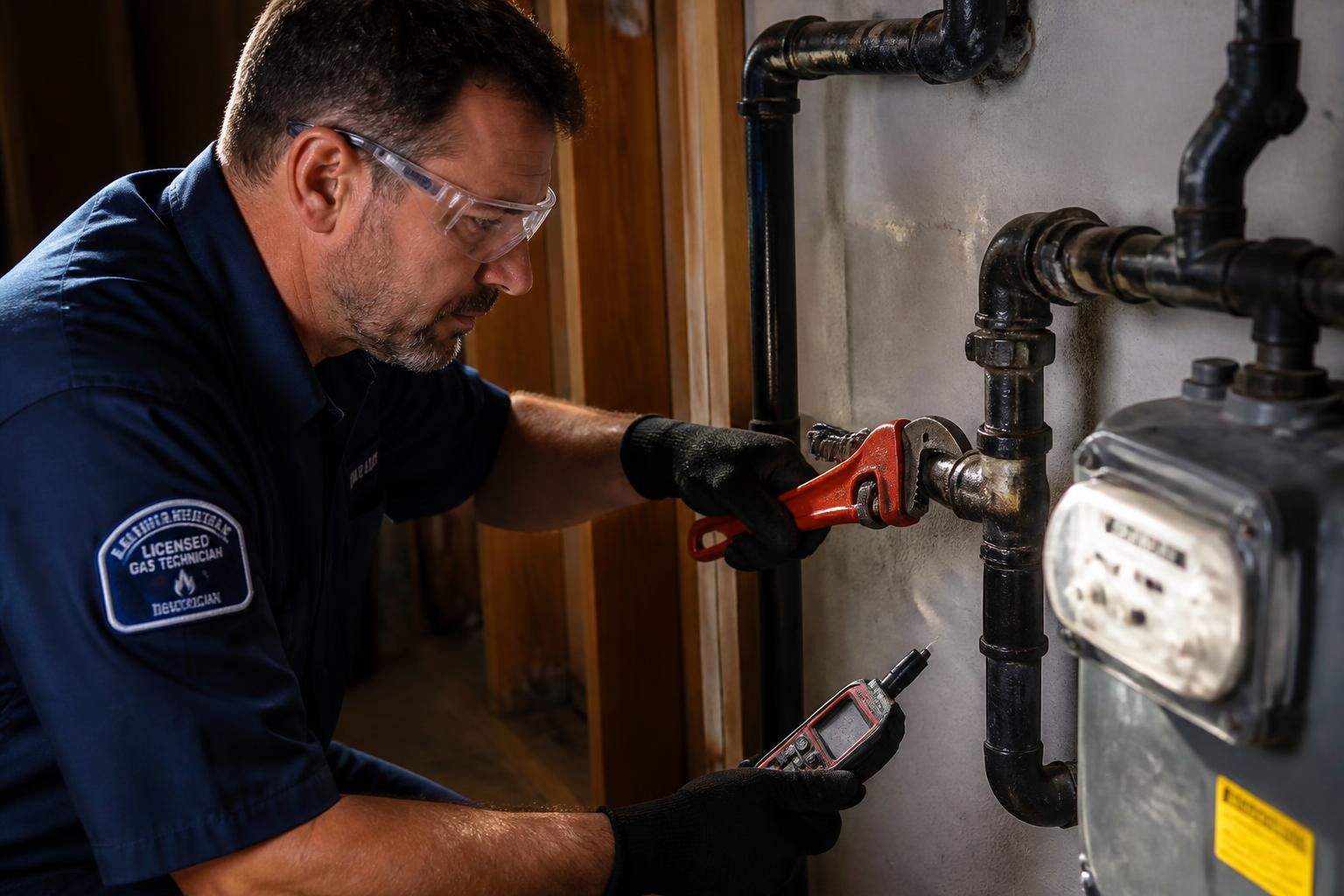
Gas line work is the least forgiving trade we perform. There is no acceptable margin of error, no partially correct installation, and no reason to use an unlicensed installer to save a few hundred dollars. Every gas line J&J Mechanical installs is sized by BTU load calculation, assembled from approved materials, pressure tested, permitted and inspected before a single appliance is connected.
We run new lines for gas ranges, dryers, water heaters, furnaces, fireplaces and log sets, outdoor grills and kitchens, pool and spa heaters, generators and shop heaters — for both natural gas and propane systems across Nottoway, Amelia, Dinwiddie and Prince Edward counties.
Load Calculation and Sizing
Gas pipe must be sized for the total connected BTU load, the distance from the meter or tank, and the number of fittings in the run. Undersized piping is the most common defect we find on existing systems: the range works fine until the furnace and water heater fire at the same time, and then everything starves. We calculate the full system load including anything you plan to add later.
Materials and Installation
Black iron pipe with approved joint compound, or CSST correctly bonded and protected per code and manufacturer instruction — improperly bonded CSST is a genuine lightning hazard and one we find in existing homes regularly. Underground runs use approved polyethylene with tracer wire and correct burial depth. Shutoffs are installed at every appliance and at accessible points in the system.
Testing, Permits and Inspection
Every new line is pressure tested and held for the duration required by code, with the gauge witnessed by the inspector. We pull the permit, coordinate the inspection, and handle the meter or tank-side connection with the utility or propane supplier. You receive the documentation, which matters at resale and for insurance.
Why choose J&J Mechanical?
- BTU load calculation including future appliance plans
- Black iron, CSST and underground PE installation
- Correct CSST bonding — a hazard we frequently find missed
- Permits pulled and inspections coordinated for you
- Documented pressure test provided on completion
Signs you should schedule service
- Adding a gas range, dryer, fireplace or generator
- Appliances underperform when several run at once
- Building an outdoor kitchen, grill or fire feature
- Converting from electric or oil to gas appliances
Local experience in Farmville
Farmville is the largest town we serve and the most mixed in building type. Between Longwood University, Hampden-Sydney nearby, the downtown commercial district and a substantial rental market, Farmville properties range from student housing and historic homes to modern commercial spaces and restaurants with rooftop mechanical equipment.
That mix means we do everything here: emergency plumbing in rental properties, commercial HVAC maintenance for downtown businesses, residential system replacement in established neighborhoods, and leak detection in historic homes where a hidden leak threatens original plaster and heart pine flooring.
Historic in-town homes, established mid-century neighborhoods, a large student rental market and a downtown commercial core with rooftop packaged HVAC equipment and food service plumbing requirements.
Farmville's summer humidity is amplified by the Appomattox River corridor, making dehumidification performance as important as raw cooling capacity in older homes with high infiltration.